As at the end of July 2026, the whole of Wales has been declared in drought by Natural Resources Wales, parts of Scotland are experiencing significant water scarcity and the Environment Agency has declared drought in half of England. July has seen just 7% of expected rainfall, falling to 1% across southern England – and there is no substantial rain on the way.
As a result, seven water companies have introduced Temporary Use Bans (TUBs), for 23 million customers – around 40% of England’s population. They are: Affinity Water, Anglian Water, Cambridge Water, Southern Water, South East Water, Thames Water and South West Water.
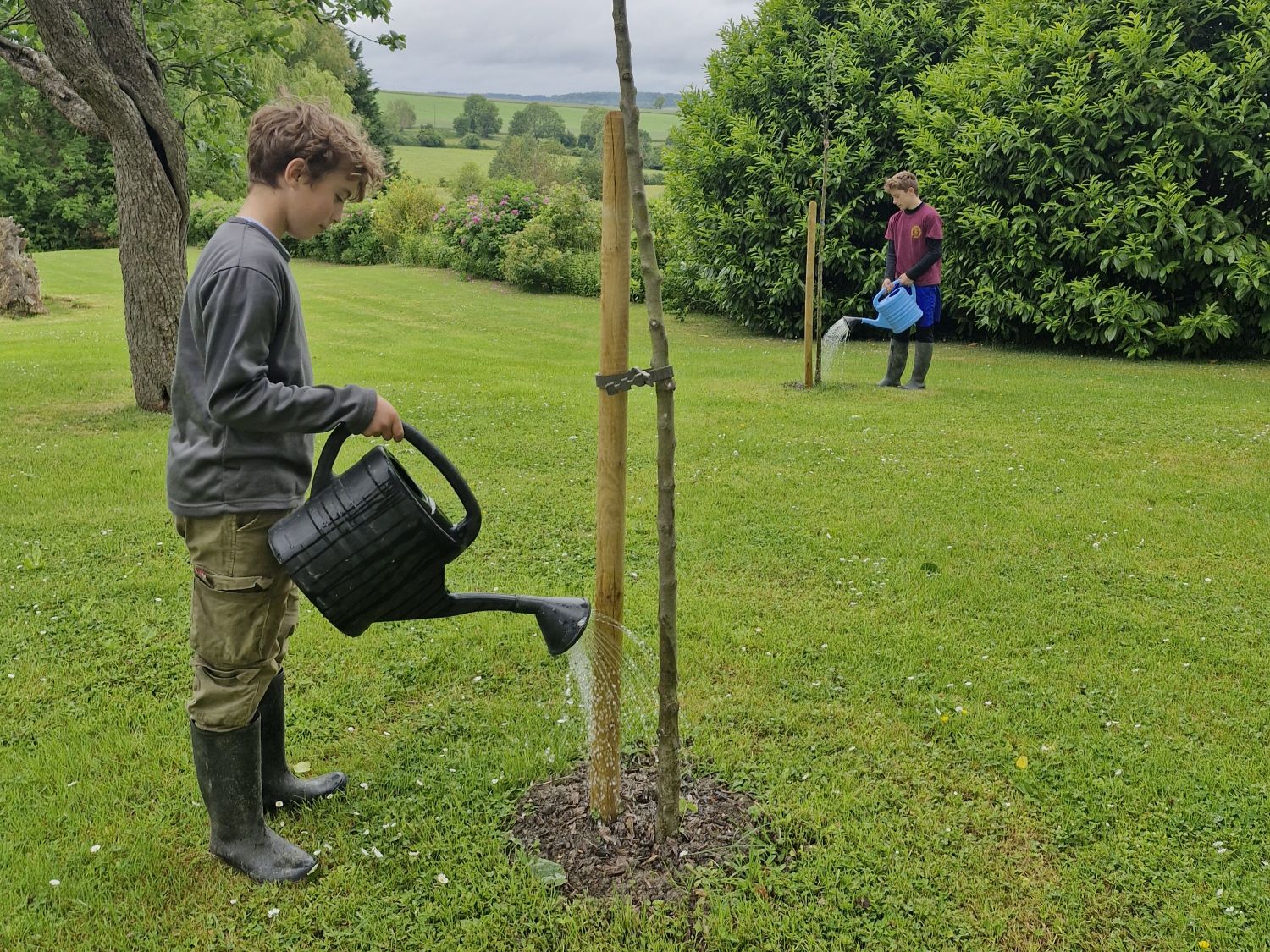
Drought conditions place newly planted trees under significant stress as they establish their root systems. However, even during a hosepipe ban, young trees can still be watered. Supporting newly planted trees through periods of drought helps safeguard the environmental and financial investment made in planting them, and is typically far more cost-effective and resource-efficient than replacing dead trees.
What is a TUB or hosepipe ban?
Temporary Use Bans (TUB) created under Section 76 of the Water Industry Act 1991 are commonly known as hosepipe bans. These have been applied to much of the country these last few weeks in response to regional drought conditions. TUBs allow water companies to restrict activities such as watering gardens with a hosepipe, watering plants on domestic premises, filling paddling pools and ponds and cleaning vehicles and patios with a hosepipe.
The purpose of hosepipe bans is to reduce demand during drought conditions and protect water supplies and the environment. Recent Environment Agency guidance notes that TUBs can reduce water demand by around 3–5%, which can be significant during a drought.
Are trees in gardens, streets or public spaces exempt from hosepipe bans?
Perhaps not so widely known is that under the ‘Update to the Drought Code of Practice 2013’, hosepipes can still be used to water standard trees, saplings, whips and hedging planted within the previous three years, where they cannot reasonably be watered by hand or with non-potable water.
In addition, standard trees in urban settings, such as street trees where there is no grass, can also be watered with a hosepipe. Community orchards and fruit trees may also benefit from separate exemptions, as food crops can still be watered with a hose where a watering can is not practical.
Do all water companies operate in the same way?
The application of restrictions and exemptions can vary between water companies, depending on the specific terms of a hosepipe ban and the guidance issued locally. It is therefore important to check the restrictions published by your water company. Water companies can also remove specific exemptions in exceptional drought circumstances where essential water supplies are at risk, but this should only happen as a last resort.

Does mulching young trees help in drought conditions?
Alongside watering, don’t underestimate the value of a generous mulch, so don’t hesitate to top up any mulch in hot weather (with landowner permission of course). Applying woodchip or other mulch around the base of a newly planted tree helps lock moisture into the soil and reduces evaporation which is a worthwhile investment when winter planting season feels a world away from summer heatwaves.
How can you encourage others to help water young trees?
If your newly planted trees don’t already have one, ‘please water me’ tags, posters and social media cards are available to download or order for free through the Arboricultural Association: Watering Young Trees.